
Should Public Decisions Be Made Using Full Cost Disclosure, or Selective Storytelling?
Municipal Forest Reserve - the facts about the 'polls'.

There is nothing inherently wrong with advocacy. Storytelling is powerful. It helps people care. It motivates action. It gives meaning to complex issues.
The problem begins when storytelling replaces disclosure.
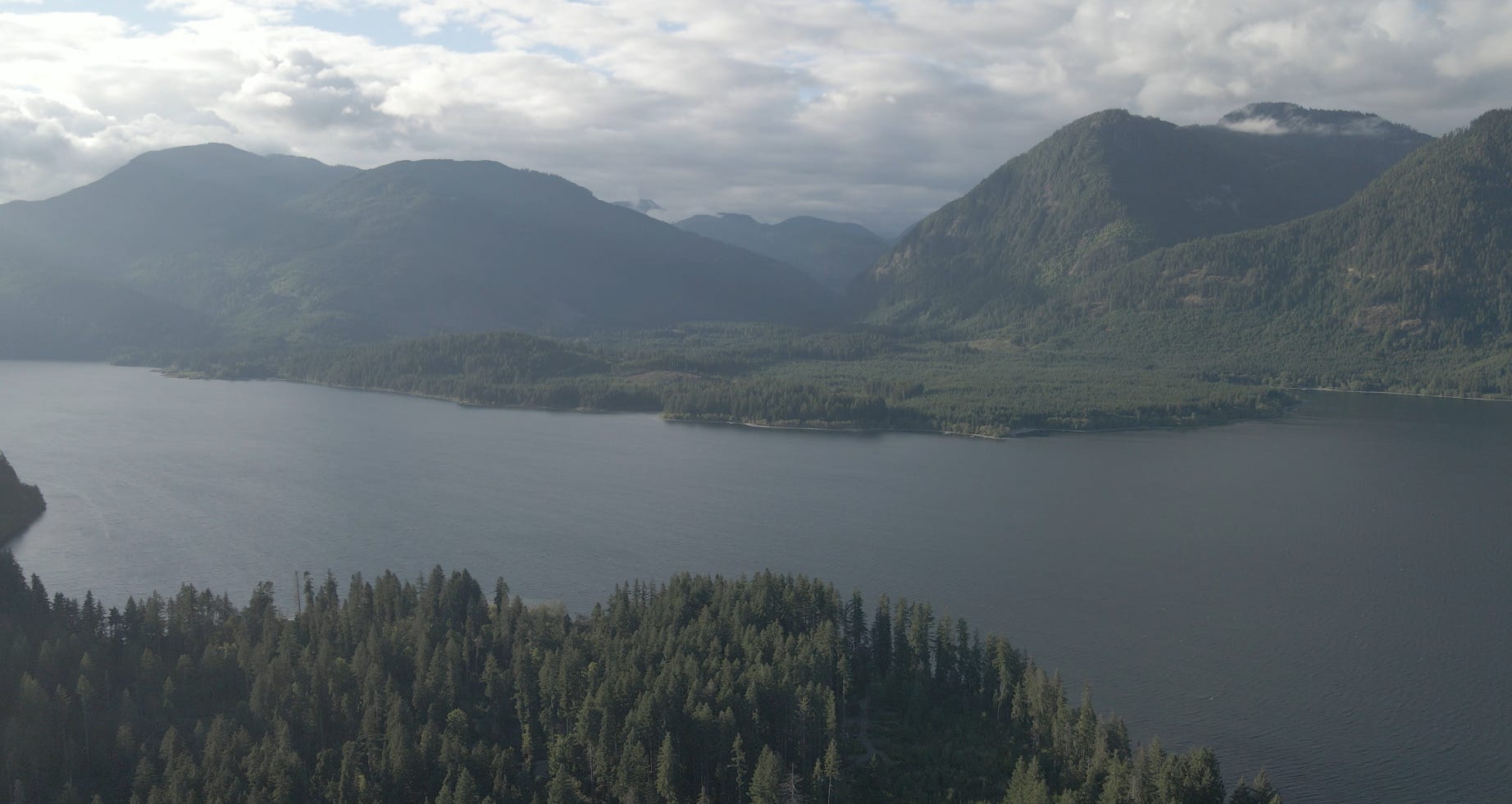
In North Cowichan, the debate over the Municipal Forest Reserve, known as the Six Mountains, has been shaped for years by a single dominant narrative. Advocacy groups, most visibly Where Do We Stand, have told residents that logging is morally wrong, that conservation was clearly chosen by the public, and that alternatives like carbon credits will take care of the financial side.
It is a compelling story. It is also incomplete.
When you slow down and read the public record, the staff reports, the survey breakdowns, and the actual financial outcomes of the alternatives that were promoted, a different reality comes into focus. Not a conspiracy. Not bad intentions. Just selective storytelling that stops right before the uncomfortable part.
That uncomfortable part is cost.
Because when decisions involve a 5,000 hectare municipal asset, the difference between a good story and a complete story is measured not in feelings, but in millions of dollars passed directly to taxpayers.
This document exists to put the missing numbers back into the conversation.
How the 2019 Pause Was Framed, and Why That Matters
The pause on logging did not begin with a decisive public vote or a clear rejection of forestry.
In February 2019, council endorsed a staff recommendation to complete existing contracts, harvest windthrow, and issue no new logging contracts while a review was conducted. It was described as temporary. One year. A chance to gather information.
What followed shaped the outcome long before the public was ever asked for input.
Council partnered with a specific group of University of British Columbia academics to lead the technical review of the forest. Their areas of expertise were conservation biology, forest carbon modeling, climate mitigation, and low carbon futures. Their published work consistently advocates for reduced or eliminated commercial harvesting in sensitive ecosystems.
Dr. Peter Arcese – conservation biology / protecting rare ecosystems
Dr. Brad Seely – forest ecosystem modelling with a heavy focus on climate change impacts and carbon sequestration
Dr. Verena Griess – forest resources management (later moved to ETH Zurich)
Dr. Clive Welham – ecological modelling / forest carbon projects
Dr. Stephen Sheppard – climate change visualization, community engagement on low-carbon futures, and “visioning” sustainable landscapes
There were no forestry revenue economists involved. No community forest practitioners whose work centers on sustained yield funding models. No experts whose primary focus is balancing ecological protection with long term municipal finance.
From that point forward, every scenario presented to council and the public flowed through that lens. Even the public engagement process itself was constrained to options pre modeled by the same group.
This was presented as expert led. What was not clearly disclosed was that the experts selected shared a common academic worldview that strongly favored protection over managed use from the outset.
That distinction matters, because it shaped not only what the public was asked, but what they were never asked.
The Survey Numbers That Keep Getting Repeated, and What They Actually Show
Advocacy groups (and Cllr. Justice who misstated in the November 19th) routinely claim that 76 percent of residents opposed logging in the Municipal Forest Reserve. That number is repeated so often it has taken on the status of fact. The statement should be made that “76% of poll respondents …” - but even then, it would not be factual.
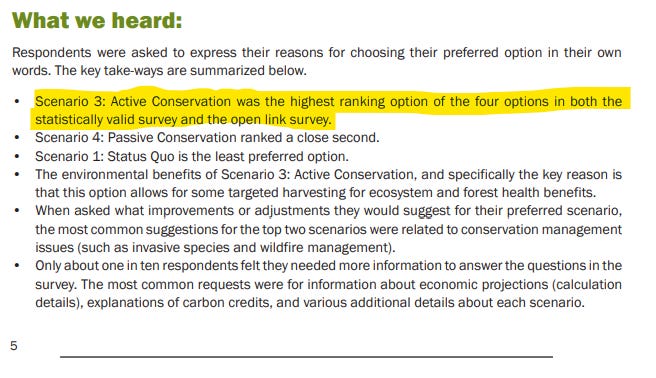
The public engagement process conducted between 2020 and 2021 showed strong support for conservation values, but it did not show majority support for zero harvesting.
Across the survey data, the strongest single preference was Active Conservation, supported by approximately 40 to 41 percent of respondents. Active Conservation explicitly includes selective, limited harvesting as a tool for forest health and funding.
When Active Conservation is combined with Reduced Harvest and Status Quo options, a clear majority of respondents supported a forest that continues to be harvested in some form.
Only about 30 to 35 percent of respondents supported passive conservation with no harvesting at all.
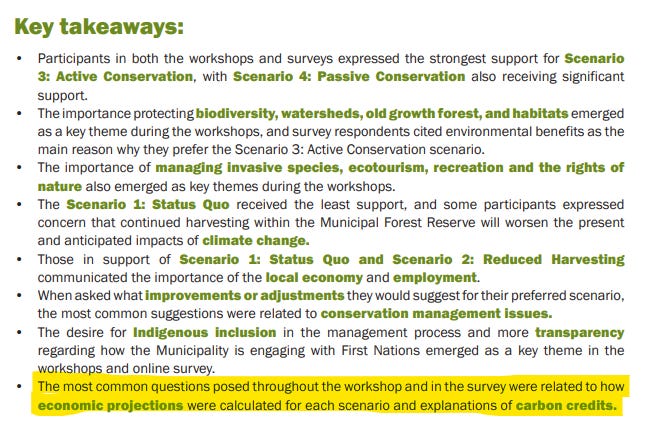
Despite this, advocacy groups routinely collapse all conservation preferences into a single category and present it as a mandate for zero logging. That is selective interpretation.
More importantly, the surveys never asked the most critical question of all.
No one was asked whether they were willing to permanently absorb the full cost of forest management through property taxes.
No one was asked whether they were comfortable replacing a self funding system with an annual structural deficit.
Those trade offs were never disclosed.
Carbon Credits, Promises, and the Reality of the Math
Carbon credits were promoted as the solution that would allow full protection without financial sacrifice.
Where Do We Stand repeatedly pointed to King County, Washington as a successful model, citing projected prices of 34 to 50 dollars per ton and suggesting similar outcomes were achievable in North Cowichan.
We now have six years of real world data.
King County’s Rural Forest Carbon Project has averaged approximately 13 US dollars per ton, or about 18 Canadian dollars. With annual reductions of roughly 9,000 to 10,000 tonnes, total revenue has landed in the range of 120,000 to 180,000 dollars per year.
North Cowichan’s Municipal Forest Reserve costs approximately 730,000 dollars per year to maintain.
Even under optimistic assumptions, a carbon credit program would leave a permanent annual deficit of roughly 550,000 to 610,000 dollars. Every year. Indefinitely.
After six years of waiting, North Cowichan has generated zero dollars in carbon revenue. The Forestry Reserve Fund has been drawn down to approximately 230,000 dollars, and the municipality recorded a 342,000 dollar deficit last year alone.
These numbers were never presented to the public during the survey process.
Because if they had been, the story would have been harder to sell.
What Selective Storytelling Looks Like in Practice
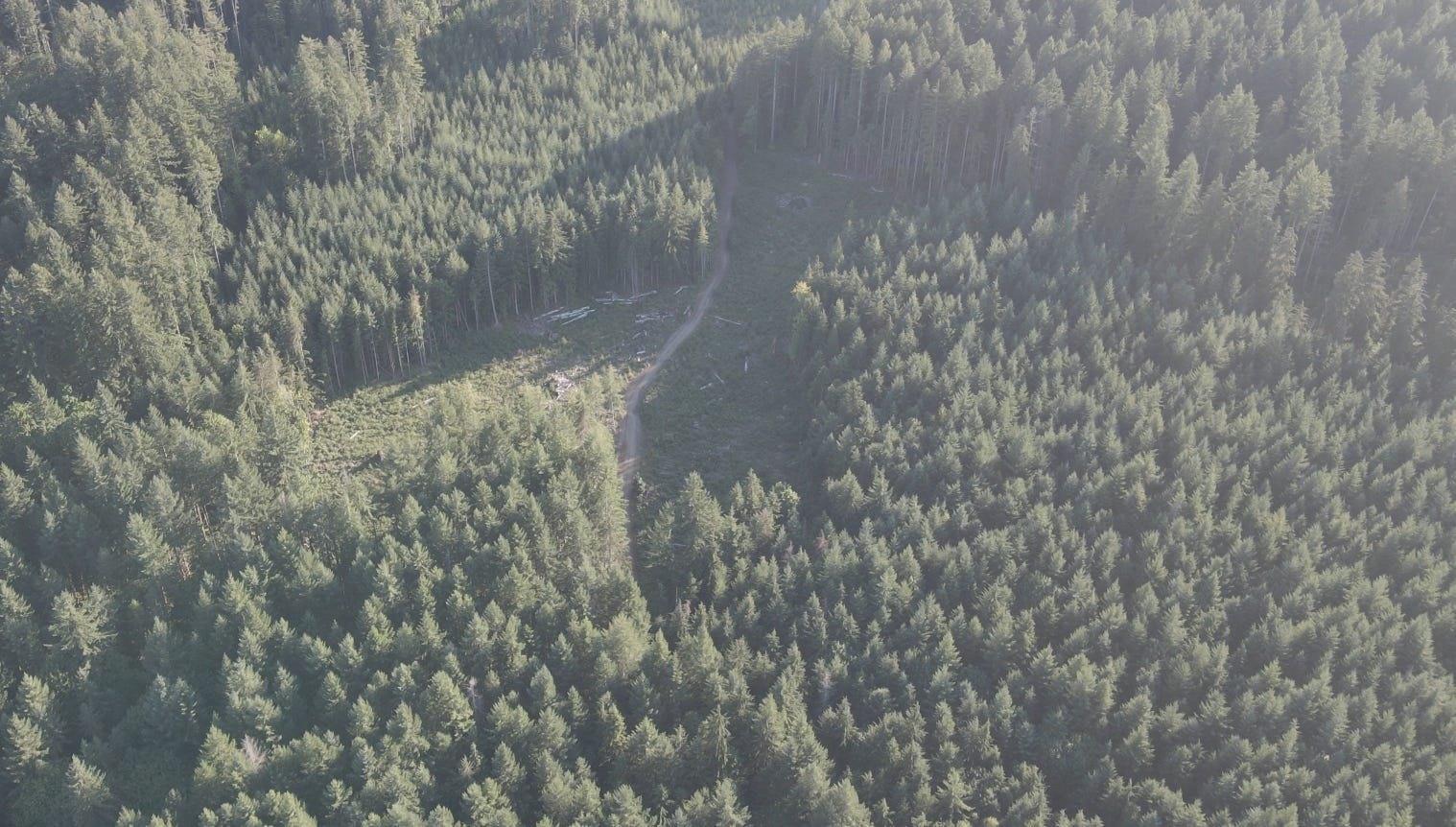
When council voted in 2025 to explore the possibility of resuming harvesting through staff analysis, not actual logging, headlines immediately declared that logging was being resumed.
Public discourse shifted instantly from policy to morality. References to residential schools, reconciliation, and ecological collapse dominated the conversation. These are serious issues, but they were used to shut down practical questions about funding, risk, and responsibility.
Council ultimately backed away, unanimously reaffirming co management discussions with the Quw’utsun Nation.
What did not change was the financial reality.
The forest still does not pay for its own care. Costs continue to be transferred to taxpayers. And the people who promoted the pause are free to move on to the next campaign without ever having to explain how the bills get paid.
That is the problem.
When Advocacy Masquerades as Local News
Selective storytelling does not only come from organized advocacy groups. It is amplified when individual activists adopt the appearance of journalism.
In North Cowichan, one of the most influential examples is Larry Pynn and his website, sixmountains.ca.
There is nothing improper about running an opinion driven website. Everyone is entitled to their views. Mr. Pynn is openly aligned with environmental activism and left leaning political positions, which is clear from both the content and the framing of his work. That in itself is not the issue.
The issue is how that work is distributed and perceived.
Sixmountains.ca does not limit itself to nature writing or ecological commentary. It actively promotes and criticizes specific councillors, comments on council decisions, and frames political outcomes in moral terms. Those articles are then repeatedly posted across nearly every local Facebook group, often verbatim, often multiple times, until they become unavoidable.
In a media environment where Meta restricts access to a multitude of opinions and facts - from established local news outlets, to independent new agencies - this matters. What can look like “local news” to many residents is, in reality, a single individual’s political advocacy, filtered through selective facts and value driven framing.
The result is not an informed community. It is an echo chamber.
Residents scrolling through Facebook do not see a disclaimer that says opinion. They see headlines. They see urgency. They see repetition. Over time, those posts begin to shape perceived consensus, especially when they align with messaging from groups like Where Do We Stand.
This is how selective storytelling scales.
It is not that anyone is lying outright. It is that only certain facts are emphasized, inconvenient numbers are omitted, and alternative perspectives are framed as illegitimate or harmful rather than debated on their merits.
When bloggers advocate for or against specific councillors, encourage voting outcomes, and flood community spaces with that content, they are no longer simply commenting on public affairs. They are actively influencing them, without the standards, balance, or accountability expected of journalism.
That influence carries weight. It helps create the impression that complex policy decisions have already been settled, that dissent is fringe, and that reopening discussion is somehow disrespectful or regressive.
In reality, it is often the opposite.
Reopening discussion is what transparency looks like when the costs were never fully disclosed the first time.
Full Disclosure Is Not Anti Conservation
None of this is an argument against protecting the forest.
It is an argument against pretending protection is free.
For seventy years, the Municipal Forest Reserve was managed using low volume harvesting, roughly one percent per year, generating revenue that funded roads, trails, fire mitigation, habitat work, and silviculture while building million dollar reserves.
That system was not perfect, but it was honest. It paid for itself.
If the community wants a different path, that choice must be made with full cost disclosure, not selective storytelling.
Because when the story ends and the budget begins, feelings do not pay the bill.
Taxpayers do.
Sincerely, Team COAP
We are always incredibly thankful for the donations that help us keep bringing the ‘other side” ! Thank you all.
e-transfer to contact@coap.ca
Monthly subscription to our Substack can be found in the ‘Subscribe’ button.
Happy Holidays !
Carbon Credits are not a familiar topic to many people... it's the offset of the so called anthropogenic global warming - that's why there are so many white lines in the skies these days, to offset jet travel, carbon credits are given to the airline industries to make them (up in the stratosphere) to block out the sun...
Here is the carbon credit life cycle explained.
https://carboncredits.com/the-carbon-credit-lifecycle/
Has anyone ever considered asking WHY are we converting carbon into a monetized status?