
Don't even use body language the wrong way! The Updated Code of Conducts- N.C. / CVRD
What exactly is IN these policies??

A Code of Conduct is common, a simple policy that one would think - “why not?”. We should have rules around bullying, conflicts of interest etc.
The public are currently calling for elected officials, or those that are running, to - ‘deal with staff’. This is framed as either ‘trimming’ of staff numbers, or asking why staff can not do the job a hired consultant does.
What do elected officials face in dealing with staff, and what would be the answers to these questions?
After talking to past elected officials, one thing becomes clear - they used to be able to talk to staff, interact regarding a policy, or a plan - this is not the case anymore…..
Staff Protections in North Cowichan and CVRD - Code of Conduct updates
CVRD Code of Conduct
This situation is very restrictive under the 19 page (!!) CVRD Code of Conduct, (signed in after the last election) which applies its broad “Bully and Harass” definition (Section 1.2.2) to all staff, including the CAO. The CVRD policy includes any unwelcome or objectionable conduct, body language, or comment, and specifically flags questioning professional competence.
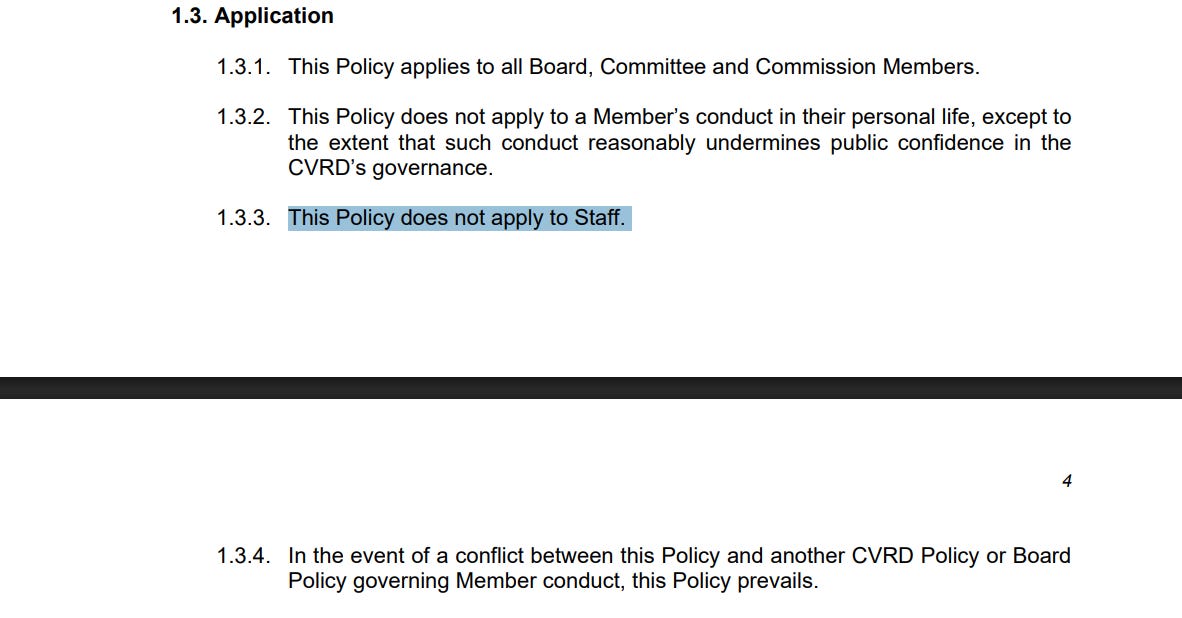
This expansive wording opens the door to complaints over everyday oversight activities. Examples of behaviour that could trigger a formal complaint under the CVRD policy include:
A Director questioning or criticising a staff report or recommendation (could be interpreted as questioning professional competence under CVRD Section 1.2.2).
Using a frustrated tone, certain facial expressions, or negative body language during a meeting (unwelcome or objectionable body language under CVRD Section 1.2.2).
Sending a blunt email asking for clarification or expressing disagreement (unwelcome or objectionable conduct or comment under CVRD Section 1.2.2).
Simply attempting to have a direct conversation with staff outside the formal chain of command (could violate both the interaction rules and the broad harassment definition).
When members of the public ask why their elected Directors or Councillors are not being more proactive, pushing back harder against certain staff recommendations, or holding staff more accountable, this is precisely why. The combination of rigid communication channels and vague, subjective harassment rules makes normal democratic scrutiny feel legally and procedurally risky. Elected officials may choose silence or excessive deference rather than risk a complaint.
North Cowichan
For many years in North Cowichan, elected councillors operated under a more flexible approach when interacting with staff. Under the previous Standards of Conduct Policy (approved in 2018 and amended in 2023), councillors could generally speak with staff on departmental matters by going through the Chief Administrative Officer or department heads, with some allowance for minor day-to-day operational conversations. This reflected a more traditional model of local government in which elected officials, as the direct representatives of the public, had reasonable access to information and could engage with the administration they were elected to oversee.
That changed with the adoption of the new Code of Conduct Bylaw No. 4053 in 2025. The updated bylaw marks a significant shift toward much stricter controls that heavily insulate staff from direct engagement with elected officials, but is far less specific than the CVRD code of conduct.
Under the new bylaw, councillors must direct all questions or inquiries regarding departmental issues or other work-related items in writing to the Chief Administrative Officer or a member of the Senior Leadership Team, with a copy to the CAO (Section 9(2)). Direct conversations with regular staff on policy or operational matters are effectively prohibited. Council members are also barred from interfering with, hindering, or obstructing staff in the performance of their duties or from impairing staff’s ability to implement Council’s policy decisions (Section 9(1)).
These rules create a very clear procedural wall. While the intent is to protect staff from undue pressure, the practical result is a substantial reduction in the ability of elected councillors to perform meaningful oversight in real time.
The chilling effect on democratic accountability is significant. The people we elect to represent us now face formal barriers when trying to engage with the bureaucracy that executes, and sometimes influences, policy. This widens the divide between elected officials and staff, tilting power further toward unelected administrators.
A particularly notable aspect of these rules concerns the Chief Administrative Officer. The CAO is the single most senior staff member and the only employee directly accountable to Council. Elected officials appoint the CAO, set their performance expectations, and have the authority to discipline or terminate them. Yet even the CAO falls under the protective umbrella of the Code of Conduct. While North Cowichan’s definition of “Staff” technically excludes the CAO from the strict written-communication rule in Section 9, the general prohibition against abusive, bullying, intimidating, or derogatory behaviour (Section 7) still applies. This means councillors must be extremely careful when questioning, criticising, or applying pressure to the CAO. What might be seen as legitimate oversight could be framed as bullying or intimidation.
Potential Discipline
Both the North Cowichan Bylaw (Sections 18 to 22) and the CVRD policy (Part 4) establish formal complaint procedures that can be initiated by staff, other members, or in some cases the public. If a complaint is upheld after investigation, elected officials can face a range of sanctions, including formal censure or reprimand by Council, a requirement to issue a public apology, removal from committees or leadership positions, restrictions on representing the municipality publicly, and in serious or repeated cases, other measures Council deems appropriate.
A Question of Redundancy
One has to wonder how much of this is truly necessary when British Columbia already has several pieces of legislation designed to address bullying and harassment in the workplace. The BC Human Rights Code protects employees from discrimination and harassment based on protected characteristics. The Workers Compensation Act explicitly recognizes bullying and harassment as significant work-related stressors, and WorkSafeBC has clear policies requiring employers, including municipalities, to prevent such behaviour. In addition, Section 153 of the Community Charter already prohibits elected officials from interfering with municipal officers and employees in the performance of their duties.
To Conclude …
Both North Cowichan’s lengthy new bylaw and the CVRD’s version appear to be staff-driven documents that elected officials ultimately approved. They place extreme emphasis on protecting staff, including the very CAO whom Council is supposed to direct and hold accountable. What was once a more collaborative relationship between councillors and staff has been replaced by formal barriers and the constant threat of subjective complaints. This raises important questions about accountability in local government: who ultimately serves whom, and how can the public expect strong representation when the hands of their elected officials are so tightly bound?
What Can Be Done?
The good news is that these policies are not set in stone. In North Cowichan, Code of Conduct Bylaw No. 4053 can be amended or repealed by a simple majority vote of Council at any time. For the CVRD, the policy must be reviewed and can be revised within twenty-four months after the first regular Board meeting following a general election. The next municipal election in October 2026 provides a clear opportunity for newly elected Directors and Councillors to revisit, amend, or significantly reform these documents to restore a healthier balance between elected oversight and staff protection.
Ask potential candidates what their thoughts are around this matter?
Team COAP
coap.ca
wwind.ca
contact@coap.ca
Canada, the country where people are always apologizing. BC, the province where no-one wants to rock the boat, and people prefer to be fake than be direct and get shit done. We absolutely do no need these kinds of bylaws when we are already such a docile (to our detriment!) people. I'm from Algeria, where normal conversation sounds like WW3. Even with all the different cultures here, the political tone is always subdued. Perhaps we need to learn from the French, or the Slavic people who just say it like it is, and nobody cries as a result.
What if... I fainted during a presentation due to the amount of overwhelm from these directives... how would that body language go over I wonder :)